AGI as an Asymptote: Physical Intelligence and the Ecosystem of Limited AI
I. The Myth of the Omniscient Monolith
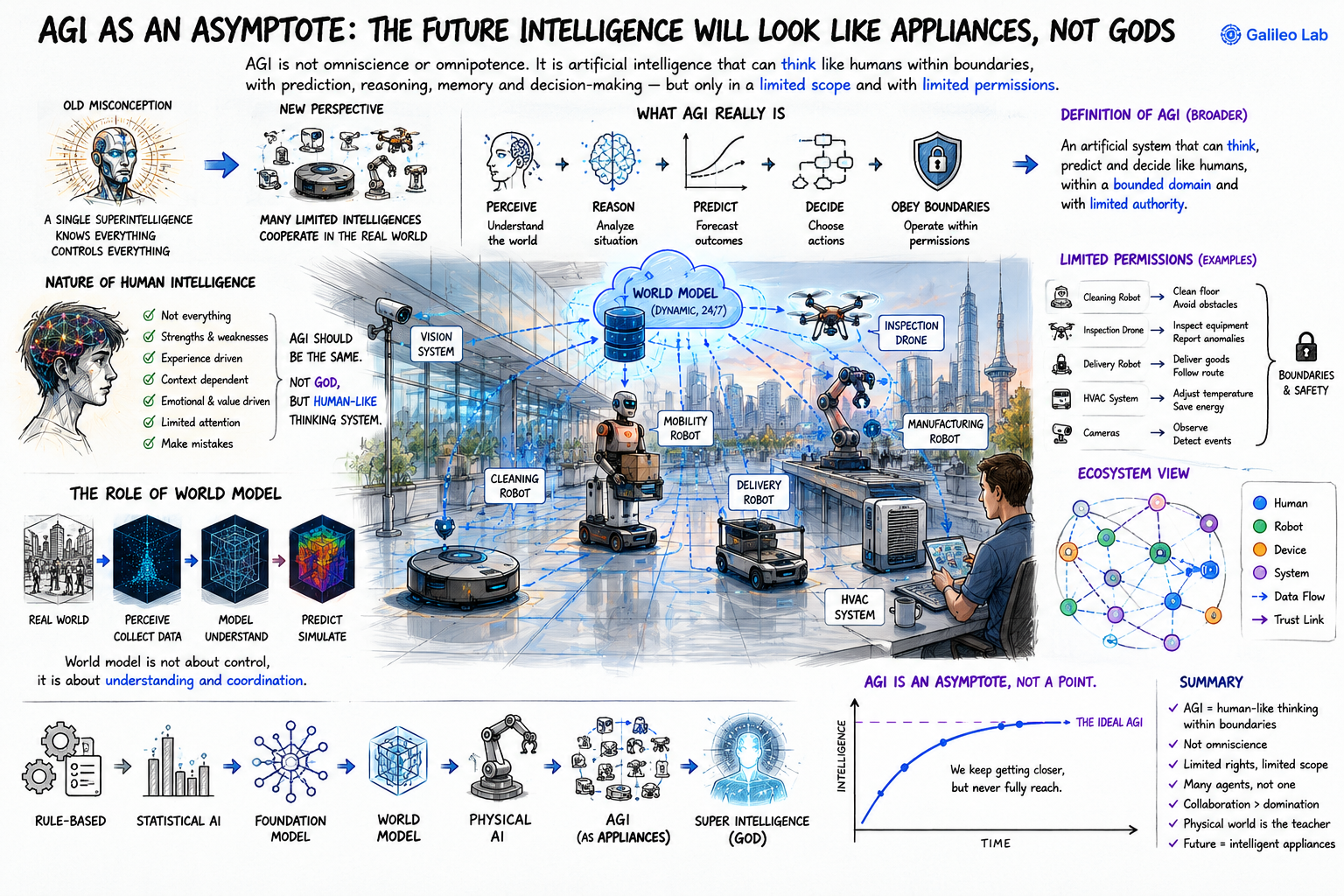
For the past decade, the dominant narrative surrounding Artificial General Intelligence (AGI) has been framed around a singular, omniscient superintelligence—a digital monolith capable of mastering all domains simultaneously through the sheer force of computational scaling. This paper proposes a radical departure from this monolithic ideal. We argue that AGI should not be conceptualized as an individual, all-powerful entity, but rather as an asymptote: a theoretical ideal that we infinitely approach but never encapsulate in a single system.
Human intelligence itself is not a monolith; it is a distributed network of modular faculties with distinct cognitive boundaries, strengths, and frailties. No single human can possess world-class mastery over quantum mechanics, industrial metallurgy, macroeconomic forecasting, and fine-motor surgery simultaneously. Analogously, the true future of AGI will emerge not as a singular, centralized super-brain, but as a highly coordinated, distributed ecosystem of specialized agents, each endowed with specific reasoning capabilities and bounded authority.
II. The Micro-Intelligence Infrastructure of the Physical World
When intelligence interfaces with the physical world, the fantasy of unconstrained digital scaling collides with the harsh realities of physical laws. In this distributed framework, household robots, industrial automated controllers, environmental inspection drones, and warehouse logistics systems do not require total cosmic knowledge; they require high-fidelity localized competence.
Consider a modern automated facility. A cleaning robot operating within this ecosystem possesses the predictive autonomy to analyze surface debris and dynamically alter its path based on real-time sensory inputs. Yet, it remains blissfully ignorant of the facility's overall grid load. Simultaneously, an advanced HVAC system optimizes localized thermodynamics, air quality, and energy consumption based on occupancy predictions and barometric trends, yet it holds no authority over the building’s security perimeters.
None of these discrete intelligences govern the whole. Each operates within a strictly defined perimeter of permissions, designed to balance operational autonomy with absolute systemic safety. Collectively, however, they cease to be isolated tools. They form a coherent, self-organizing matrix where world models serve as a non-intrusive orchestrating layer—not to micromanage individual actions, but to predict cross-agent interactions, maintain physical consistency, and proactively mitigate conflicts, while humans remain at the apex to supply high-level constraints, ethics, and teleological objectives.
III. The Inescapable Gravity of Physical Intelligence
Physical intelligence remains the ultimate crucible for AGI because the real world imposes a non-negotiable tax: friction, material heterogeneity, thermal dynamics, and environmental volatility. Unlike purely digital simulations where environments can be idealized and variables neutralized, physical AI must constantly negotiate real forces in real-time. It must understand that an unexpected change in surface friction can cause a catastrophic failure in localized locomotion, and that human behavior is inherently non-linear.
Therefore, the objective of engineering physical intelligence shifts away from creating an unrestrained, fully autonomous deity. Instead, the focus becomes the cultivation of reliable, predictable, and embedded intelligence. The goal is an ecosystem analogous to the organs within a biological body: each organ is highly specialized, bounded in its scope of authority, yet completely synchronized to sustain a coherent, living function.
IV. The Triadic Principles of the Agent Ecosystem
To transition from a chaotic collection of machines to a stable, emergent intelligence network, we introduce three foundational principles that govern this finite ecosystem:
- Fricial (Physical Interaction Awareness): The intrinsic capability of an individual agent to perceive, respect, and adapt to the immediate physical boundaries and resistances of its local environment. It is the tactical, sensory intelligence of touch, force, and physical reality.
- Artifriction (The Engineering of Constraints): The deliberate learning and implementation of behavioral and physical boundaries. Artifriction is the framework through which an AI understands its limitations—both the laws of physics (gravity, inertia) and artificial parameters (operational permissions and safety guardrails) that prevent algorithmic runaway.
- Resonial (Temporal-Spatial Harmony): The horizontal coordination mechanism that synchronizes multiple autonomous agents across time and frequency. Resonial architecture ensures that independent, finite intelligences operate in a state of destructive interference regarding conflict, and constructive interference regarding efficiency—allowing them to co-exist in the same physical space without operational overlapping or collision.
V. Conclusion: Emergence Over Omniscience
By viewing AGI as an asymptote, we relieve computer science of the dangerous and impractical burden of building an all-powerful, unconstrained machine. The true promise of advanced artificial intelligence lies not in the creation of an omniscient entity, but in the emergent stability, resilience, and efficiency of a network of limited intelligences.
Progress will be measured not by how close a single model comes to knowing everything, but by how seamlessly a thousand finite models can communicate, predict, and adapt alongside one another. By designing robust coordination mechanisms rooted in physical realities, we pave the way for a world where every machine thinks a little, predicts a little, decides a little—and collectively shapes an industrial and civilizational reality that functions with absolute reliability.